
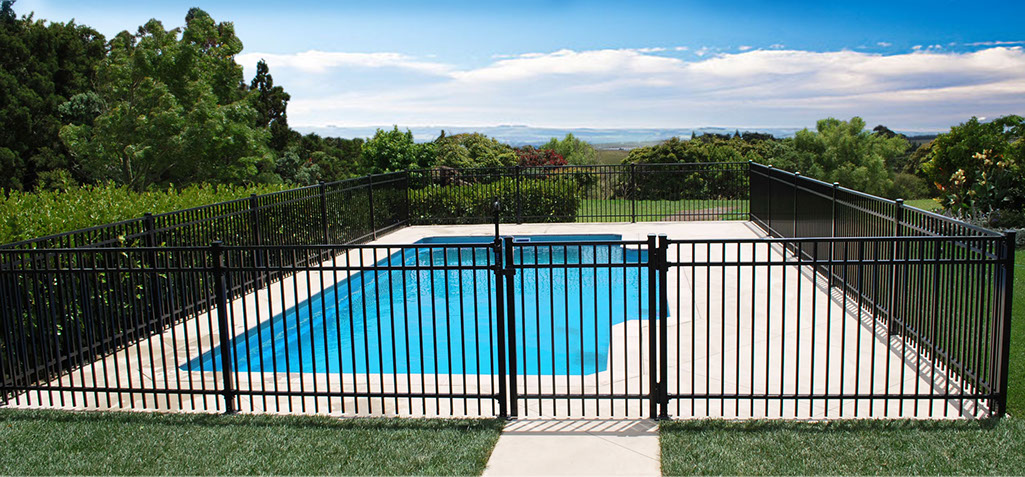
A pool is one of the best parts of owning a home in Southwest Florida — but it also comes with a serious legal and safety responsibility. Florida has some of the strictest pool barrier laws in the country, and for good reason: drowning is the leading cause of death for children ages 1–4 in the state. If you own or are building a pool, here’s exactly what your fence needs to do to stay compliant and keep your family safe.
Is a pool fence required by law in Florida?
Yes. Under the Florida Residential Swimming Pool Safety Act (Florida Statutes Chapter 515) and the Florida Building Code, every new residential pool must have at least one approved safety feature. A 4-foot barrier fence is by far the most common — and most reliable — way to meet that requirement. Other options include approved safety pool covers, exit alarms on doors leading to the pool, and self-latching devices, but a proper barrier fence is the gold standard that satisfies inspectors and protects children and pets.
The 6 key pool barrier requirements
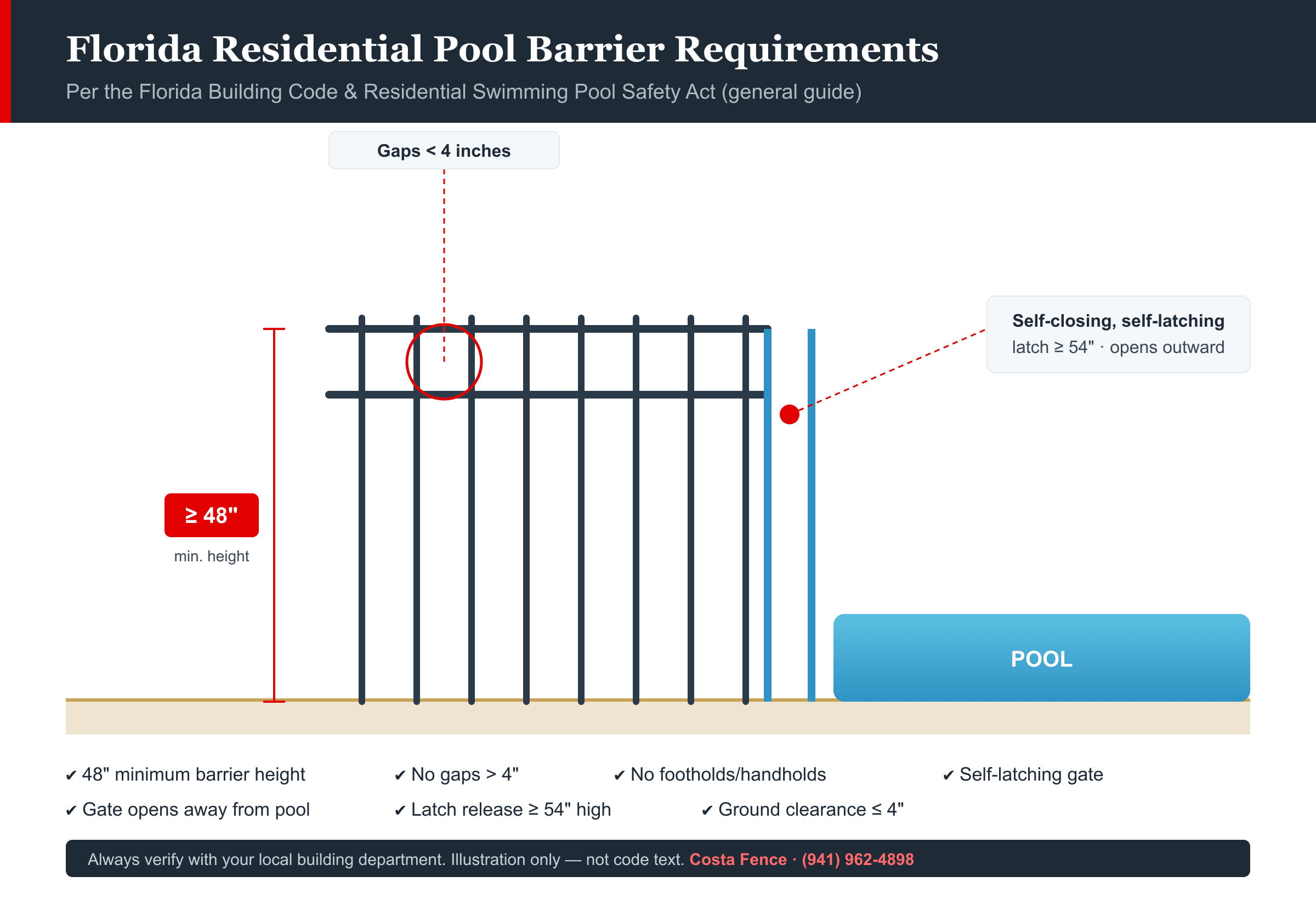
| Requirement | What Florida code requires |
|---|---|
| Height | At least 48 inches (4 ft) measured from the outside ground surface. |
| Ground clearance | No more than 4 inches of gap beneath the fence. |
| Openings | No gap large enough to pass a 4-inch sphere through. |
| No climb aids | No horizontal footholds or handholds a child could use to climb over. |
| Gates | Self-closing and self-latching, opening outward away from the pool. |
| Latch height | Latch release at least 54 inches above the ground (out of a child’s reach). |
1. Height — minimum 48 inches
The barrier must be at least four feet tall on the side facing away from the pool. Taller barriers (54″–72″) are common for added privacy and security, especially with aluminum or vinyl.
2. No gaps wider than 4 inches
Spacing between vertical pickets — and the gap under the fence — must be small enough that a 4-inch sphere can’t pass. This is why closely spaced aluminum fencing is such a popular pool choice.
3. No footholds or handholds
Horizontal rails and decorative features can’t create a “ladder” a toddler could climb. Barrier-grade designs keep climbable surfaces on the pool side or eliminate them entirely.
4. Self-closing, self-latching gates
Every gate must swing shut and latch on its own, every time, with no one holding it. It must open outward, away from the pool, so a child leaning on it can’t push through.
5. Latch at least 54 inches high
The gate’s release mechanism must sit high enough that a small child can’t reach it — a minimum of 54 inches above the ground.
6. Home wall as a barrier? Extra rules apply
If a wall of your house forms one side of the barrier, any doors leading to the pool typically need an approved exit alarm or self-closing/self-latching hardware. When in doubt, a full perimeter fence is the simplest way to pass inspection.
Not sure if your pool fence is up to code?
Costa Fence installs code-compliant pool barriers across Sarasota and Southwest Florida — measured right, permitted, and inspection-ready.
Get My Free Pool Fence Quote →
Or call (941) 962-4898
Best fence types for a Florida pool
- Aluminum — the #1 pool choice: rust-proof, elegant, closely spaced pickets that meet the 4-inch rule, and it never corrodes in salt air.
- Vinyl (PVC) — great for privacy pools; low-maintenance and coastal-tough. See the best coastal fence materials.
- Mesh safety fencing — removable, popular with young families as a secondary layer.
- Glass or picket styles — allowed if they still meet every barrier requirement above.
Permits, HOA rules and inspections
In Sarasota County and surrounding municipalities, pool barriers require a permit and an inspection, and HOA communities often specify approved styles and colors. This is where a licensed local installer saves you time and rework. Costa Fence handles permits, HOA approvals and inspection scheduling so your barrier passes the first time — the right way, the first time.
Frequently asked questions
How tall does a pool fence have to be in Florida?
At least 48 inches (4 feet), measured from the ground on the outside of the barrier, with no gaps or footholds that would let a child climb over.
Does a pool gate have to be self-closing in Florida?
Yes — gates must be self-closing and self-latching, open outward away from the pool, and have the latch at least 54 inches above the ground.
Is a pool fence required by law in Florida?
Yes. New residential pools must have at least one approved safety feature under the Residential Swimming Pool Safety Act, and a 48-inch barrier fence is the most common.
How wide can gaps in a pool fence be?
No opening may allow a 4-inch sphere to pass, and ground clearance under the fence must not exceed 4 inches.
Protect your family with a code-compliant pool fence
Secure your home. Elevate your property. Built to last. Get your free pool barrier estimate today.
Costa Fence · (941) 962-4898 · Sarasota, FL